

Learning shapes is a vital part of early childhood education. Shape worksheets offer a simple, fun way for children to recognize, name, mark, count, match, and identify shapes while building essential early math skills.
To make learning shapes more engaging, I have created eight free printable shape worksheets in PDF format for preschool and early elementary students. These worksheets feature a variety of simple activities that allow children to practice shape recognition while also developing skills in counting, drawing, fine motor control, observation, and problem-solving.
Children will learn about familiar 2D (two-dimensional) shapes, such as circles, squares, triangles, and rectangles. Each activity is designed to be simple and accessible for young learners, while also providing useful exercises that teachers and parents can easily incorporate into their lessons.
Best of all, these shape-based worksheets are available as free, printable PDF files; you can download and print them for use at home, in the classroom, or for homeschooling.
What Will Children Learn from These Shape Worksheets?
Recognizing shapes involves more than just memorizing their names. As children work with various shapes, they begin to distinguish differences in sides, corners, sizes, and patterns.
These worksheets provide children with opportunities to practice:
- Recognizing common 2D shapes
- Naming different shapes
- Counting sides and corners
- Matching shapes
- Tracing and drawing shapes
- Completing shape patterns
- Counting shapes
- Identifying specific shapes
- Improving pencil control
- Developing visual discrimination
- Building early geometry skills
The activities can be used individually or as part of a comprehensive lesson on shapes.
8 Free Printable Shape Worksheets
Here is a detailed overview of the 8 shape worksheets included in this free printable PDF collection.
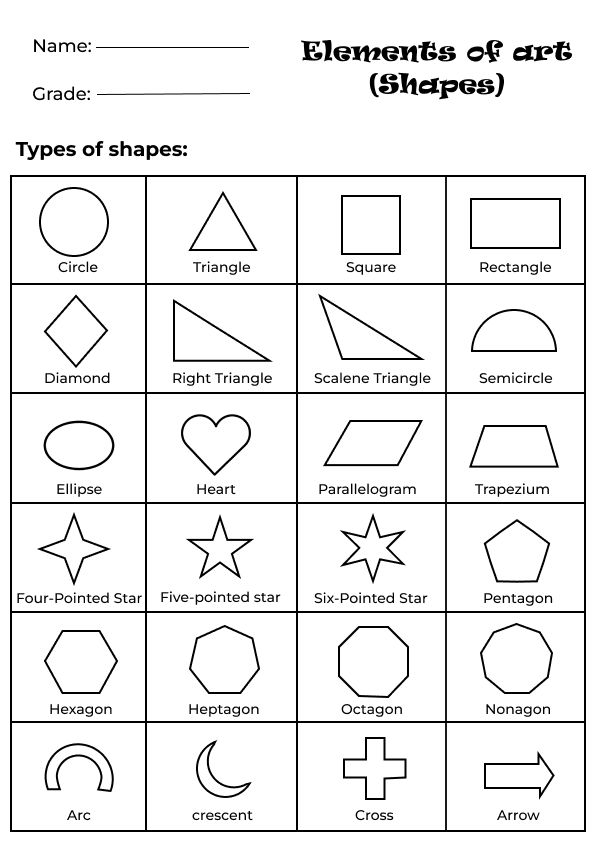
Types of Shapes:
The first worksheet introduces children to various types of basic shapes.
Young learners can explore familiar shapes such as:
- Circle
- Square
- Triangle
- Rectangle
- Oval
- Other simple 2D shapes.
This worksheet is useful for introducing shapes, as it allows children to become familiar with the appearance and names of common shapes.
Teachers can use it as an introductory activity before moving on to more challenging shape exercises.
Parents can use the worksheet at home by asking children to point to each shape, name it, and find similar shapes around the house.
Learning focus: Shape recognition and vocabulary.
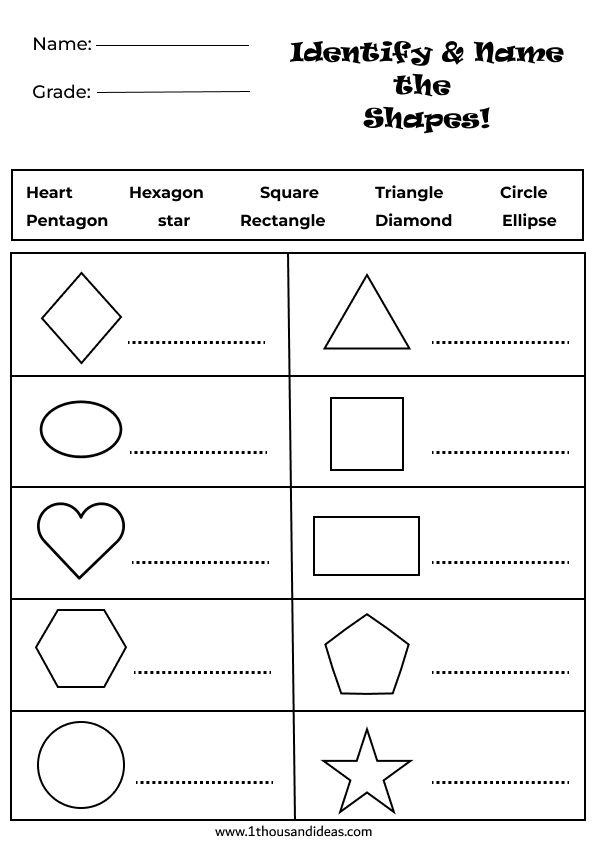
Identify & Name the Shapes:
The second worksheet helps children practice identifying shapes and naming them.
Children observe the shapes closely and determine the name of each one. This activity reinforces the connection between a shape’s visual appearance and its correct name.
For young learners, repeating the names of shapes is a key part of building an early vocabulary related to geometry.
You can make this activity more interactive by asking children questions such as:
“What shape is this?”
“Can you find another shape that looks the same?”
“Where in your classroom can you find this shape?”
This transforms a simple worksheet into an opportunity for conversation and observation.
Learning focus: Shape recognition and vocabulary building.
Shapes, sides, and corners:
Once children are familiar with basic shapes, they can begin to learn about their specific characteristics.
This worksheet on shapes, sides, and corners gives children the opportunity to closely examine various shapes and count their sides and corners.
For example, children can compare a triangle with a square and observe that the number of sides or corners is not the same.
This activity encourages children to look beyond a shape’s overall appearance and focus on its specific attributes.
It also introduces fundamental geometry concepts in a simple, age-appropriate manner.
Learning focus: Counting sides, identifying corners, and understanding the properties of shapes.

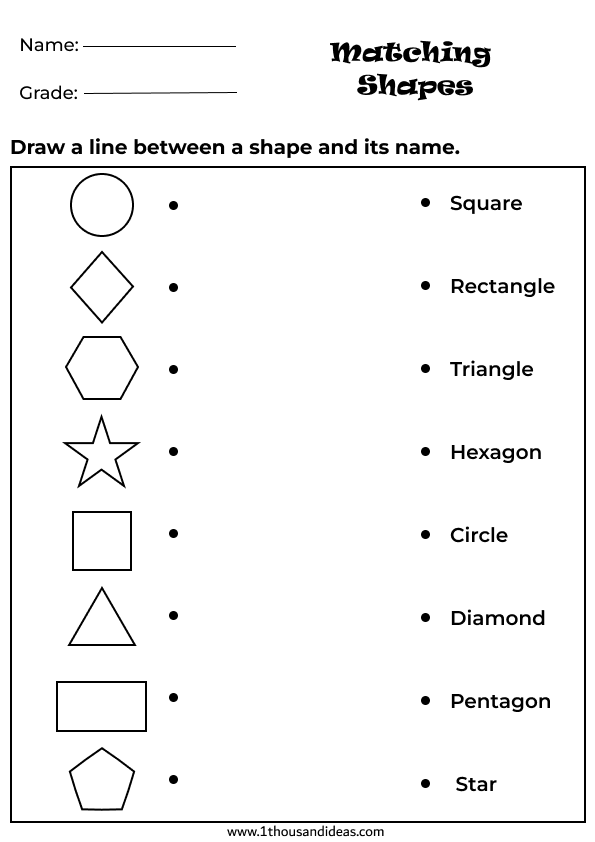
Matching Shapes:
Matching activities are a simple way to strengthen visual recognition.
In this shape-matching worksheet, children identify various shapes and connect or match them with their corresponding names or examples.
Matching activities encourage children to compare visual information and recognize similarities and differences.
This type of activity can be particularly useful for preschool-aged children who are just beginning to learn shape-related vocabulary.
To extend this activity further, ask children to find similar shapes in their surroundings.
For example:
- A clock can look like a circle.
- A book can look like a rectangle.
- A window can look like a square or a rectangle.
- A traffic sign can have a familiar geometric shape.
This helps children understand that shapes are not limited to worksheets but are also part of the world around them.
Learning focus: Visual matching and shape recognition.
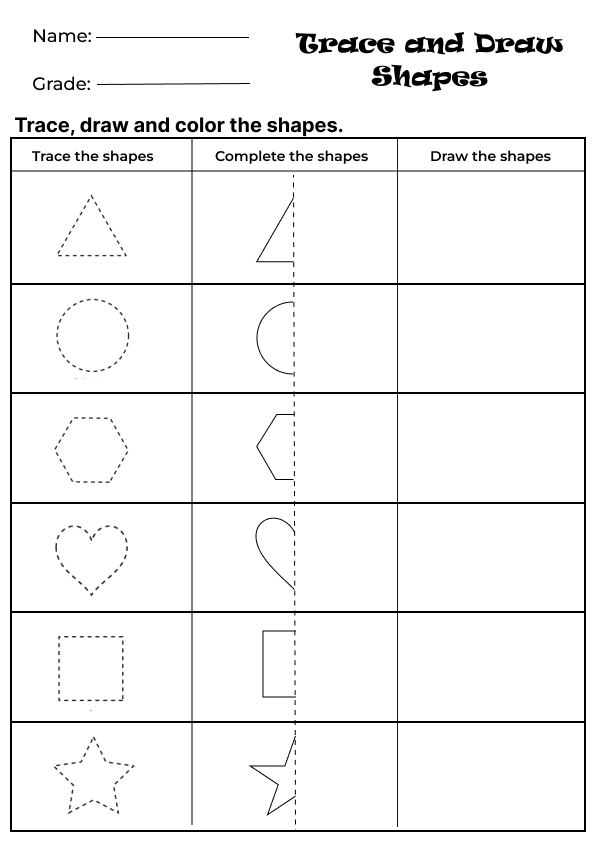
Trace and Draw Shapes:
The fifth worksheet provides children with the opportunity to practice tracing and drawing shapes.
Tracing is particularly beneficial for young learners, as it allows them to practice pencil control while following the outlines of shapes.
After tracing, children can attempt to draw the shapes independently.
This activity supports the development of:
- Fine motor skills
- Pencil control
- Hand-eye coordination
- Shape recognition
- Drawing confidence
Children can also color the shapes after completing them, making the activity more creative and enjoyable.
Learning focus: Fine motor development, tracing, and drawing.
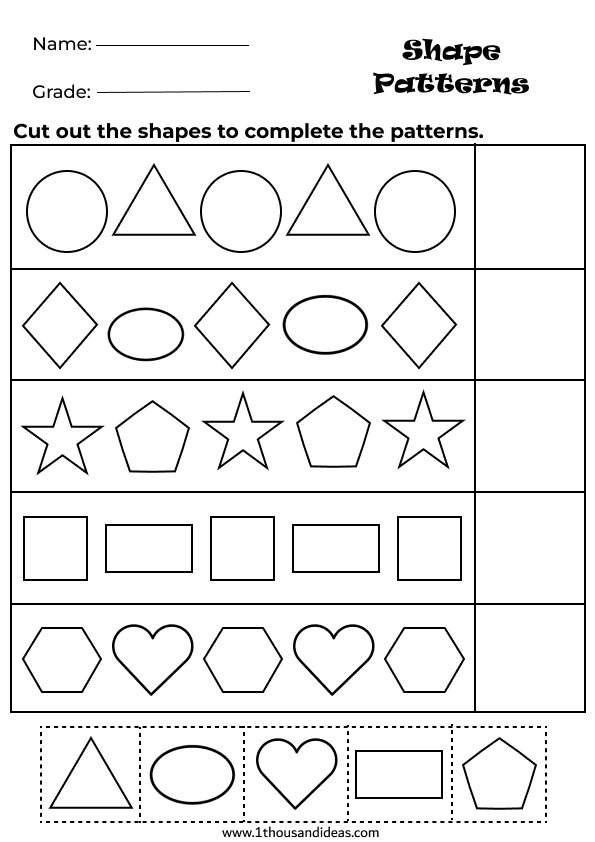
Shape Patterns:
Recognizing patterns is a key early math skill, and shapes offer an engaging way to introduce this concept.
In this shape-pattern worksheet, children observe a sequence of shapes and determine what comes next.
They may need to identify a repeating sequence or select, draw, cut, and paste the correct shape to complete the pattern.
For example:
Circle → Square → Circle → Square →?
Children need to observe the sequence and understand what is being repeated.
Pattern activities help develop logical thinking, observational skills, and early problem-solving abilities.
Learning focus: Pattern recognition, sequencing, and logical thinking.
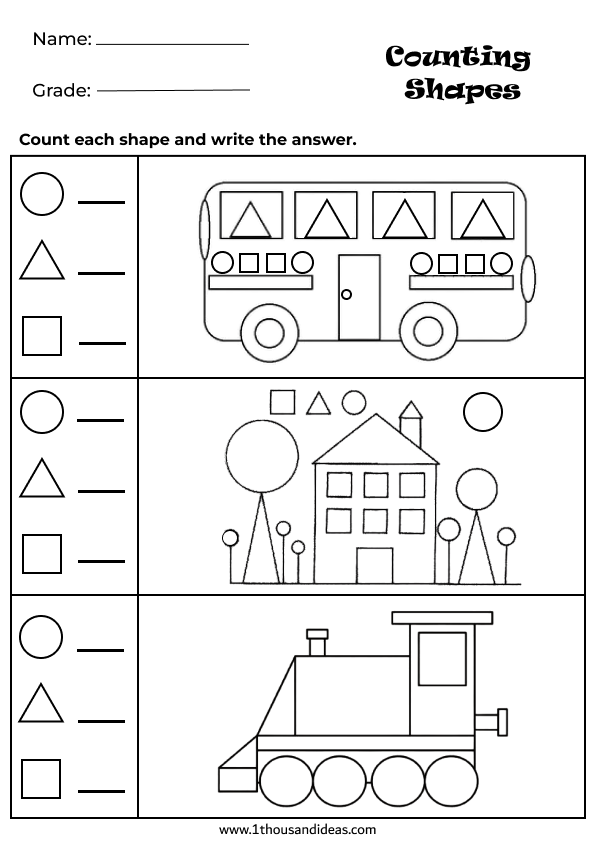
Counting Shapes:
The seventh worksheet combines shape recognition with counting practice.
In this activity, children examine a collection of various shapes and count how many of each type are present.
For example, they might need to count the number of circles, triangles, squares, or rectangles in a given picture.
This activity encourages children to observe the page closely while practicing their counting skills.
It also helps them understand that the same shape can appear in different sizes or locations.
You can make the activity even more engaging by asking the children to find shapes in the classroom after completing the worksheet.
Learning focus: Counting, observation, and shape recognition.
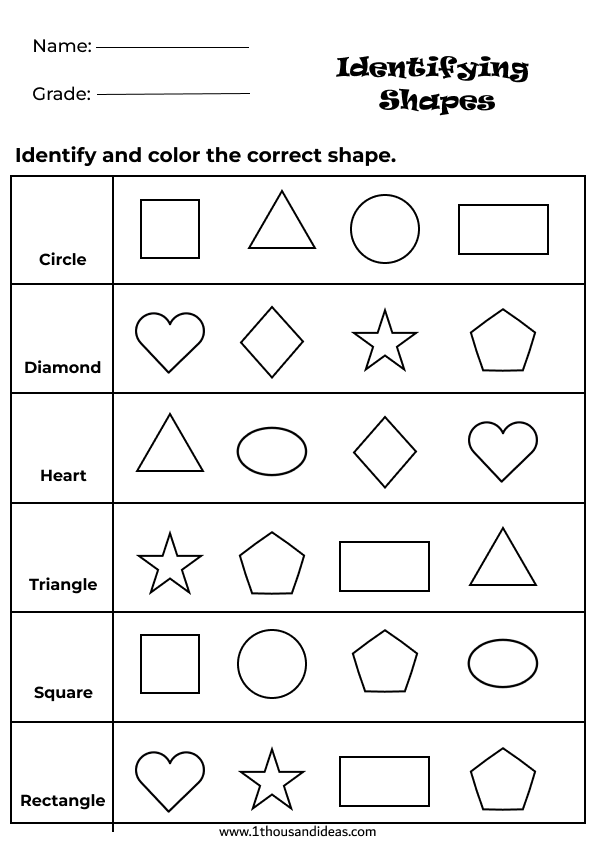
Identifying Shapes:
The final worksheet provides further practice in identifying various shapes.
In this activity, children examine groups of shapes and identify the correct shape based on the instructions. Some tasks may require students to locate or color a specific shape.
This worksheet can also serve as a simple review activity once children have completed other exercises related to shapes.
It allows teachers and parents to assess how confidently children can recognize and distinguish between common shapes.
Learning focus: Shape recognition, visual discrimination, and review.
Why Use These Shape Worksheets?
- Engaging and Interactive: Designed with fun activities to keep children interested in learning.
- Perfect for Preschool & Early Elementary: Ideal for young learners just starting to explore shapes.
- Develops Essential Skills: Helps build geometry knowledge, problem-solving abilities, and hand-eye coordination.
- Easy to Use at Home or in Class: Printable and ready-to-use worksheets for teachers, parents, and homeschoolers.
How to Use These Printable Shape Worksheets
There are many ways to use these worksheets in a learning environment.
Use them for a lesson on shapes.
Start by introducing some basic shapes. Show the children real-life objects that resemble these shapes, and then give them one of the worksheets to complete.
Use them for independent practice.
After teaching the concept of shapes, provide the students with a worksheet for independent practice.
Include coloring activities.
Let the children color the shapes after completing the activity. This makes the worksheets more enjoyable and provides young children with extra fine motor skills practice.
Use them for assessment.
Worksheets can also be used after a lesson on shapes to assess what the children have learned.
Set up a shape learning center.
Print out several worksheets and place them in a math or shape learning center. Students can work at their own pace through various activities.
Make learning about shapes more fun.
Worksheets are useful, but children can learn even more when worksheets are combined with hands-on activities.
After completing the worksheets, ask the children to become “shape detectives.”
Give them a simple challenge:
“Can you find five circles in our classroom?”
They might find a clock, a plate, a button, a wheel, or some other round object.
You can also ask the children to look for rectangles, squares, triangles, and ovals around them.
Another interesting activity is to give children the opportunity to create pictures using cut-out shapes. They can combine circles, squares, rectangles, and triangles to make houses, robots, animals, vehicles, or other creative images.
This helps children understand that larger pictures and objects can be created by combining different shapes.
Download & Start Learning!
Ready to make learning shapes easier and more fun?
These shape worksheets are available as free printable PDFs for teachers, parents, homeschoolers, and young learners.
You can download and print the worksheets to use for classroom activities, homework, extra practice, math centers, or home learning.
Whether your child is learning to recognize a circle for the first time or practicing sides, corners, patterns, and counting, these activities offer an easy way to practice early geometry skills.
Download free printable shape-related worksheets and give children the opportunity to learn, practice, trace, count, match, and identify shapes through play.
Final Thoughts
Learning shapes is a key milestone in early mathematics, and the right activities can make this process much more enjoyable for young children.
These eight free, printable shape worksheets offer a variety of activities to practice shape recognition, naming, matching, tracing, drawing, counting, and patterns. They are designed to allow children to practice repeatedly without the learning process feeling tedious or difficult.
Teachers can use them as part of preschool or early math lessons, while parents can print them out for extra practice at home.
Featuring colorful activities, simple instructions, and diverse ways to explore shapes, these printable worksheets can help children build confidence as they develop foundational geometry skills.
📥 Download Now and Make Learning Shapes Fun!



Pingback: 3D Shapes Model for School Project | Free Templates Included - 1thousandideas
Pingback: 7 Inspiring Mixed-Media Collage Ideas to Spark Creativity - 1thousandideas
Pingback: Cubism Art by Kids: A Gallery-Style Wall Display - 1thousandideas