

Lines are among the most fundamental elements of art. They help students understand how artists use various types of lines to create shapes, outlines, patterns, textures, movement, and intricate details within an artwork. From a simple straight line to an energetic zigzag or playful spirals, different types of lines can completely transform the appearance and impression of a work of art.
If you are teaching the elements of art, introducing students to lines is an excellent starting point. Line is one of the seven fundamental elements of art, and understanding the various types of lines provides students with a strong foundation for drawing and visual expression.
To make learning more interactive, I have created a collection of “Elements of Art Lines” worksheets that students can use to identify, copy, practice, and create various types of lines.
These printable worksheets are suitable for art teachers, elementary students, homeschoolers, classroom activities, and budding artists. They offer students an easy way to learn line-related terminology while building drawing confidence and fine motor skills.
In this post, you will learn about the different types of lines in art and discover how these printable line art worksheets can be used in your classroom or at home.
What Are the Different Types of Lines in Art?
Before diving into the worksheets, let’s explore some common types of lines that artists use:
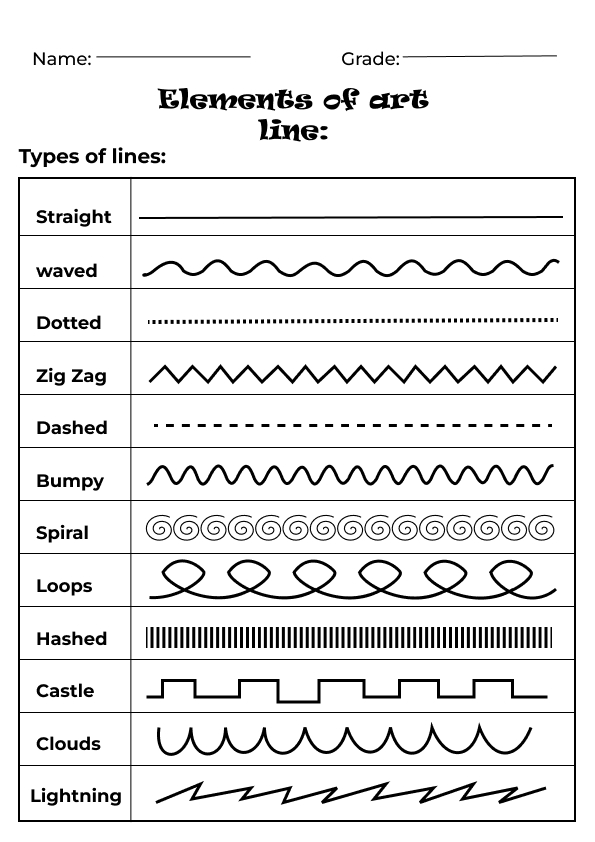
- Straight: vertical, horizontal, or diagonal, creating structure and stability.
- Wavy: gentle, flowing curves that add movement and softness.
- Dotted: A series of dots creating a light or broken effect.
- Zigzag: sharp, angular lines that add energy and excitement.
- Dashed: Short, evenly spaced dashes create a segmented effect.
- Bumpy: Uneven, rounded bumps create a textured look.
- Spiral: Curving around a central point creates a swirling effect.
- Loop: Repeated rounded loops add rhythm and playfulness.
- Hashed: Short, closely spaced parallel strokes creating shading.
- Castle: Step-like formations resembling a castle wall.
- Cloud: Soft, fluffy curves mimicking cloud shapes.
- Lightning: Jagged, unpredictable angles resembling lightning bolts.
Now, let’s look at the four worksheets designed to strengthen students’ understanding of lines.
Elements of Art Lines Worksheets
These “Art Lines” worksheet activities are designed to provide students with numerous opportunities to practice line-related vocabulary and drawing skills.
Instead of asking students to memorize the names of different lines, the worksheets encourage them to observe, identify, copy, and create them.
This makes the activity more interactive and hands-on.
The worksheet collection includes activities such as:
- Identifying types of lines
- Learning line vocabulary
- Copying various lines
- Drawing lines
- Creating line patterns
- Practicing controlled movements
These activities can be completed individually or used as part of a larger art lesson.
1. Learn the Names of Different Types of Lines
The first worksheet introduces students to the names of various types of lines.
Students can look at examples and match the appearance of each line to its name.
This is particularly helpful for young students who are just beginning to learn art vocabulary.
The worksheet presents different line styles in a clear, visual format, making it easy for children to remember them.
What students practice:
Student practice:
- Recognizing different line styles
- Learning art vocabulary
- Observing visual differences
- Matching names with examples
This worksheet can be used as an introduction before students move on to more independent drawing activities.
2. Copy the lines:
The second activity gives students the opportunity to replicate various types of lines.
Each line is presented as an example, and students draw a matching line alongside it.
This simple activity can be very beneficial for young artists, as it combines art practice with hand control.
Students need to observe the direction, shape, and movement of each line before attempting to recreate it.
Skills Developed
This worksheet can help students practice the following:
- Hand-eye coordination
- Pencil grip
- Observation
- Fine motor skills
- Confidence in drawing
- Ability to focus
It also serves as a useful introductory activity before a drawing lesson.

3. Practice Different Lines
The third worksheet provides students with additional opportunities to practice drawing lines.
Students can work through the examples one by one, focusing on replicating the general shape of each line.
Encourage students not to worry about making every line identical.
The goal is to help them become comfortable using various movements and experimenting with their drawing tools.
This simple experiment can introduce students to the concept that the nature of a line can change depending on the art tool used.
Try out different drawing tools
You can make this activity more engaging by allowing students to try the following:
- Pencils
- Colored pencils
- Crayons
- Markers
- Oil pastels
Ask students whether the same line looks different when created with different tools or materials.
This simple experiment can introduce students to the concept that the nature or quality of a line can change depending on the art tool used.

4. Create Your Own Line Patterns
The final activity gives students greater creative freedom.
Instead of simply copying a single line, students can use a variety of line types to create their own patterns and designs.
This is where the lesson shifts from practice to creative expression.
Students can combine straight, curved, zigzag, spiral, dotted, dashed, and other types of lines to create unique artwork.
Encourage creative exploration.
Ask students to:
- Combine two or three types of lines.
- Create a pattern by repeating a line.
- Fill a section using various lines.
- Create a decorative border.
- Create a line drawing using only black and white.
- Use different colors for different types of lines.
There is no single correct answer for creative line patterns.
The aim is to encourage students to experiment and discover how lines can be used in artworks.

Why Use These Worksheets?
Engaging and Interactive: Hands-on learning keeps students engaged.
Easy to Use: Simple instructions make it beginner-friendly.
Enhances creativity: Encourages students to explore and experiment.
Improves fine motor skills: Helps with hand control and coordination.
Line Art Ideas for Students
Once students understand the different types of lines, they can use them to create more advanced artwork.
Try these simple ideas:
Line Landscape
Use horizontal, curved, and zigzag lines to create a landscape.
Line Animal
Draw an animal using various types of lines instead of realistic details.
Line Flower
Use curved, spiral, and looped lines to create flowers and leaves.
Abstract Line Art
Fill a page with intersecting lines and add color to the different sections.
Line Pattern Bookmark
Students can create a small bookmark filled with their favorite line patterns.
These activities show students that lines can be used for much more than just sketching objects.
Frequently Asked Questions
What are the seven elements of art?
The seven commonly taught elements of art are line, shape, form, color, value, texture, and space.
Line is often introduced first because it is used in many different types of artwork.
Why is line important in art?
Lines can help artists create outlines, shapes, textures, patterns, movement, and visual details.
Lines can also contribute to the mood and visual character of an artwork.
What are some types of lines in art?
Common examples include straight, curved, wavy, zigzag, dotted, dashed, spiral, looped, and hatched lines.
Students can explore many other variations of line as they develop their drawing skills.
Which age group can use these online worksheets?
These worksheets can be adapted for young elementary students, budding artists, homeschoolers, and students being introduced to the elements of art.
Teachers can adjust the activity based on the students’ age and skill level.
Can these worksheets be used for homeschool art lessons?
Yes, they can be used as part of a homeschool “Elements of Art” curriculum, as standalone drawing lessons, or as a creative art activity.
How can I make the practice of drawing lines more enjoyable?
Allow students to experiment with various drawing tools and colors.
You can also shape the lines into patterns, abstract art, animals, landscapes, flowers, or other creative drawings.
Final Thoughts
Learning about lines is not a complicated process.
With the help of these worksheets focused on ‘lines’—one of the elements of art—students can learn the names of various types of lines, practice drawing them, and use them to create their own unique patterns and designs.
These worksheets offer a simple and structured learning progression:
Learn ← Identify ← Copy ← Practice ← Create
This makes them useful for both formal art lessons and creative classroom activities.
Whether you are an art teacher, a homeschooling parent, a primary school educator, or an artist just starting, these printable ‘line worksheets’ can help introduce students to one of the most important elements of art.
Print the worksheets, give students pencils or colored drawing materials, and encourage them to experiment with various types of lines.
Most importantly, remind students that their lines do not need to be flawless; every line can be part of a creative idea.
Download the printable worksheets and start exploring the world of lines in art!



Pingback: 8 Engaging Shape Worksheets to Make Learning Easy for Kids! - 1thousandideas
Hello! I love this worksheet! I am wondering where or how I access the worksheet? I don’t see anywhere to click. When I click on the “Elements of Art” hyperlink it just takes me to a Pinterest board. Can you tell me how to find these worksheets to print?
Hi Liz! 😊
Thank you so much for your kind message — I’m really glad you love the worksheet! I’ve updated the post and added direct PDF download buttons below each worksheet image so you can easily access and print them now.
Let me know if you have any trouble, and thank you again for your support!
I’m often to blogging and i actually respect your content. The article has actually peaks my interest. I’m going to bookmark your site and maintain checking for new information.
There’s certainly a lot to know about this topic.
I really like all the points you made.